

















Advancing Women’s Leadership in an AI-Shaped Africa


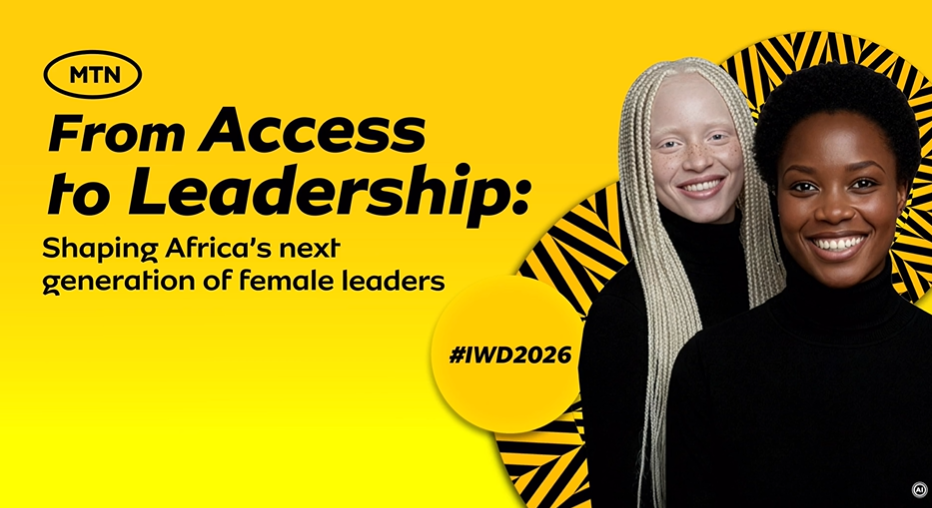
“Women are tired of hashtags. We need action.”
That stark assessment, voiced during a recent intergenerational dialogue convened by MTN Group, captures a broader inflection point. As artificial intelligence reshapes economies, industries and power structures, the question is no longer whether women are included but whether they are positioned to influence how this transformation unfolds.
The dialogue brought together global and industry leaders: Sanda Ojiambo, Assistant Secretary-General of the United Nations Global Compact; Angela Wamola, Head of Sub-Saharan Africa at the GSMA; Nompilo Morafo, MTN Group Chief Sustainability and Corporate Affairs Officer; and Selorm Adadevoh, MTN Group Chief Commercial, Strategy and Transformation Officer, alongside young African women navigating leadership in a rapidly evolving digital economy. The central message was unambiguous: in an era of accelerating technological power, representation without influence is no longer sufficient.
As Sanda Ojiambo noted early in the discussion, “AI will help us make better and more informed leadership decisions, but decision making will always be human. Decision making must be accountable, transparent, inclusive and it must think about the future.” This underscores a defining reality: while AI is reshaping how decisions are made, it does not remove the need for accountable, inclusive leadership. It elevates it.
AI is already reshaping how capital is allocated, how risk is assessed, and how organisations operate. In this context, unequal access to leadership is not simply a social concern, it is a strategic and economic risk. If women remain underrepresented where these decisions are made, the systems shaping Africa’s next growth cycle risk embedding inequality at scale.
As Angela Wamola emphasised, “For Africa, you will have to be bold and courageous because the headwinds are very strong but the opportunity is far more.” Capturing this opportunity will require deliberate, bold action, not incremental change.
Excluding women from leadership in AI-driven sectors narrows the talent pool, weakens decision-making and constrains innovation. At scale, these gaps become embedded in products, platforms and institutions. For African economies pursuing productivity, competitiveness and inclusive growth, this is a material strategic risk.
A critical distinction emerging from the dialogue is between access and influence. Mentorship remains important, but without sponsorship, networks and real pathways into decision-making, it has limited impact. Advice alone does not unlock access to capital, procurement pipelines or boardrooms. In a fast-moving digital economy, delayed inclusion compounds structural disadvantage.
The younger women participating in the dialogue were clear – they are not seeking symbolic inclusion, but practical access: to funding, to leadership spaces, and to decision-makers willing to share power. As one participant reflected, “We don’t just want to be included, we want to be part of shaping the decisions.” Another added, “Opportunities need to be real and accessible, not just spoken about.” Their message was direct: inclusion must translate into measurable opportunity.
As Selorm Adadevoh noted, “As a leader, the biggest trait is empathy and bringing the human back into the room.” In a period defined by technological acceleration, this reminder is critical: leadership must remain grounded in human experience, even as systems become more automated.
As Nompilo Morafo reflected, “Leadership is not about titles or perfectly knowing the answer to all the questions. True leadership is about understanding that you need to be listening and getting advice from others.” In a period of rapid technological change, this openness is not just a leadership trait, it is a strategic necessity.
For Africa, the challenge is not only to adopt new technologies, but to shape them with intent. As digital infrastructure expands, those with access to capital, education and networks will move faster. Without deliberate intervention, women and girls risk remaining at the consumer edge of technology, rather than participating in its design, ownership and governance.
The broader context reinforces the urgency. Gains in gender equality are not guaranteed, and global consensus around inclusion is increasingly under pressure. At the same time, AI is accelerating structural shifts across sectors. The stakes are no longer limited to representation, they extend to who shapes the systems that will define economic and social outcomes for decades.
Businesses, in particular, carry significant responsibility. They determine access to opportunity through hiring, leadership pipelines, investment decisions and partnerships. As AI reshapes the economy, these choices will determine whether progress expands participation or reinforces exclusion.
For MTN, this is a strategic imperative. Digital transformation must be inclusive by design. Connectivity alone is insufficient, pathways into leadership, technical disciplines, innovation ecosystems and governance structures are equally critical.
In an Africa increasingly shaped by AI, advancing women’s leadership is not only a social imperative – it is an economic and strategic one. It will influence decision quality, institutional resilience, innovation depth and the sustainability of growth.
Access remains important. But in this next phase of transformation, it is influence, authority and leadership that will determine who defines the future.