











Enabling digital access for displaced communities


Country: South Sudan
The challenge and what MTN wanted to achieve
South Sudan continues to face significant displacement pressures, driven by conflict in neighbouring Sudan, the Democratic Republic of Congo and Burundi. Since 2023, more than 600 000 people have crossed into South Sudan from Sudan alone, placing additional strain on already fragile infrastructure and limiting access to essential services. Displaced populations and host communities often lack affordable connectivity, access to digital services and the skills needed to use them safely and effectively. MTN South Sudan sought to enable affordable, meaningful digital access for refugees and internally displaced persons (IDPs), supporting communication, learning, livelihoods and access to humanitarian services while strengthening community resilience.
What we did
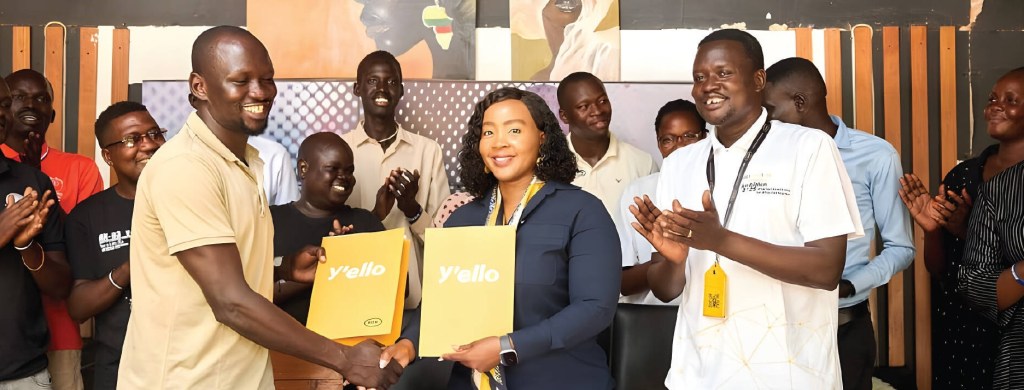
Under the Y’ello Care 2025 initiative, MTN South Sudan launched a targeted digital inclusion programme focused on connectivity, smartphone access and digital literacy. We deployed 4G-powered, solar-enabled internet hubs in Mangateen (IDP settlement) and Gorom (refugee settlement), providing free or subsidised access to humanitarian digital services, including e-learning, e-health and child protection platforms. Solar-powered charging stations addressed power constraints.
To improve device access, we enabled smartphone availability for refugee and host community households through a blended model of donated devices and MoMo-enabled instalment financing, supported by smart device-locking technology. Digital literacy training covered mobile money use, online safety and service navigation, with youth and women trained as community digital facilitators. The programme was delivered in partnership with NGOs, site coordinators and humanitarian actors, aligned to the UNHCR Connectivity for Refugees principles
Outcomes and impact
The programme reached over 2 800 refugees and IDPs, with a strong focus on women and youth. Smartphone access was enabled for 200 households within one month, while community engagement sessions strengthened understanding of digital safety, financial services and access to humanitarian support. Refugee youth were enrolled into the MTN Skills Academy, supporting digital job-readiness training. Local partnerships were strengthened, building trust and enabling co-delivery in displacement-affected areas
Lessons learnt
The programme highlighted the importance of solar-powered infrastructure, simple bundle structures and local partnerships in humanitarian contexts. These insights are informing a scalable Group approach to refugee connectivity, with expansion to additional settlements planned and a post-programme impact assessment scheduled to guide future implementation.